Someone gave you the wellbeing job. Nobody gave you the toolkit.
Everything a Chief Wellbeing Officer would build in their first 90 days: measure the organisation, listen before designing, make the money case, fix the systems. Seven modules, built for the person doing this on top of the day job.
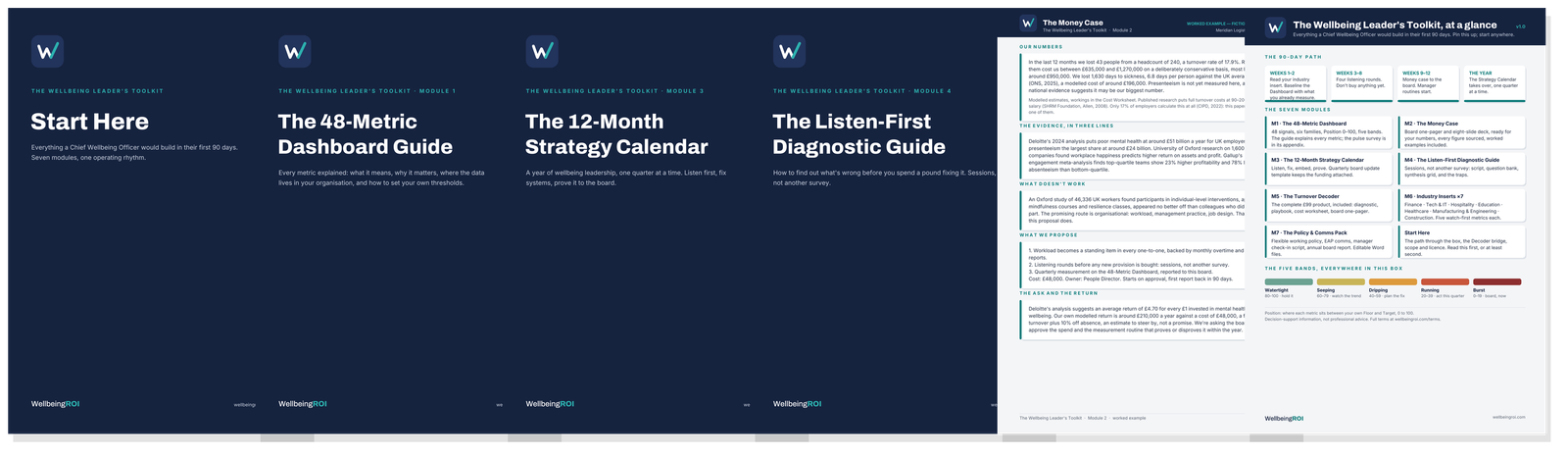
Five pages from the files you'd receive
Each picture is cut from the product itself. Click one to read it at full size.
Built for whoever leads wellbeing
HR leads, ops directors, people managers, founders: the people who carry wellbeing alongside everything else. Each module is one piece of that job, done for you and ready for your numbers.
One consultancy day costs more than this whole system.
What's in the box
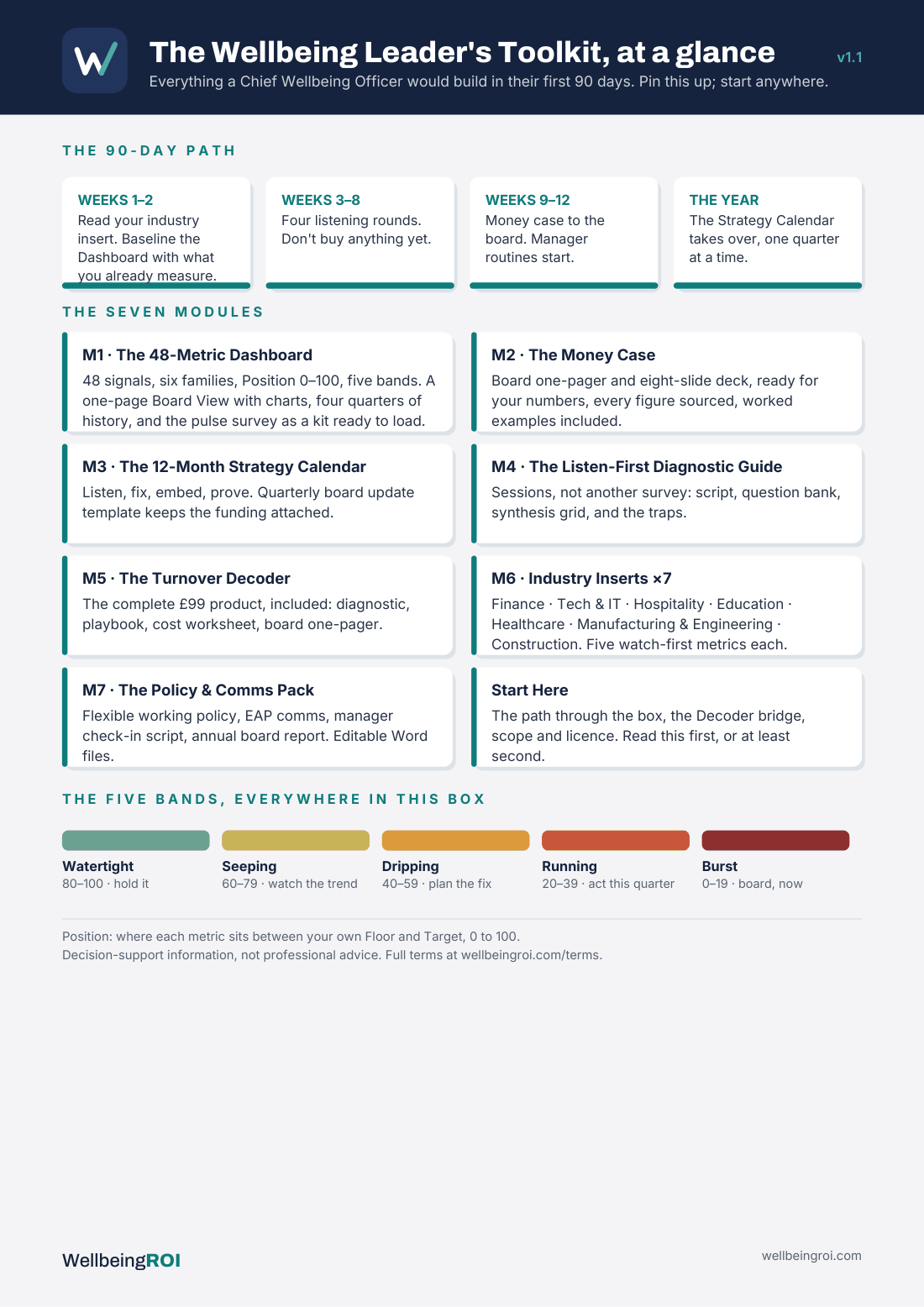
Seven modules and a Start Here guide that walks you through the 90-day path. Spreadsheets and Word templates you edit, PDFs you keep beside you, a board deck you present.
The 48-Metric Dashboard Module 1
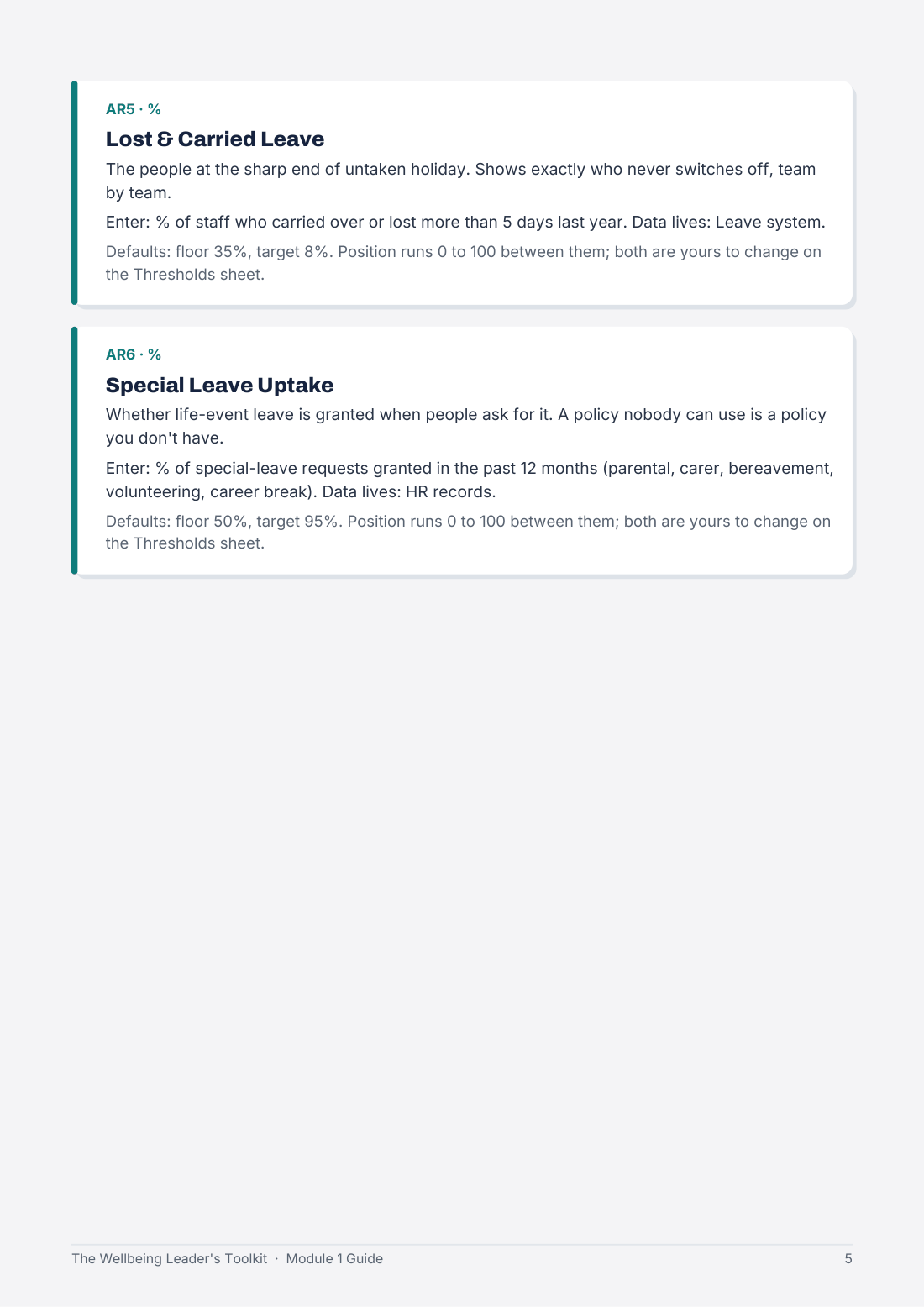
A working spreadsheet that turns 48 wellbeing signals into a quarterly, board-ready picture. Every metric scores 0 to 100 against your own floor and target, drawn as a bar, named in five bands from Watertight to Burst. A one-page Board View charts the six families for the board, four quarters of history draw their own trend lines, and the quarterly pulse survey comes as a kit you load into your own form tool. The guide explains every metric.
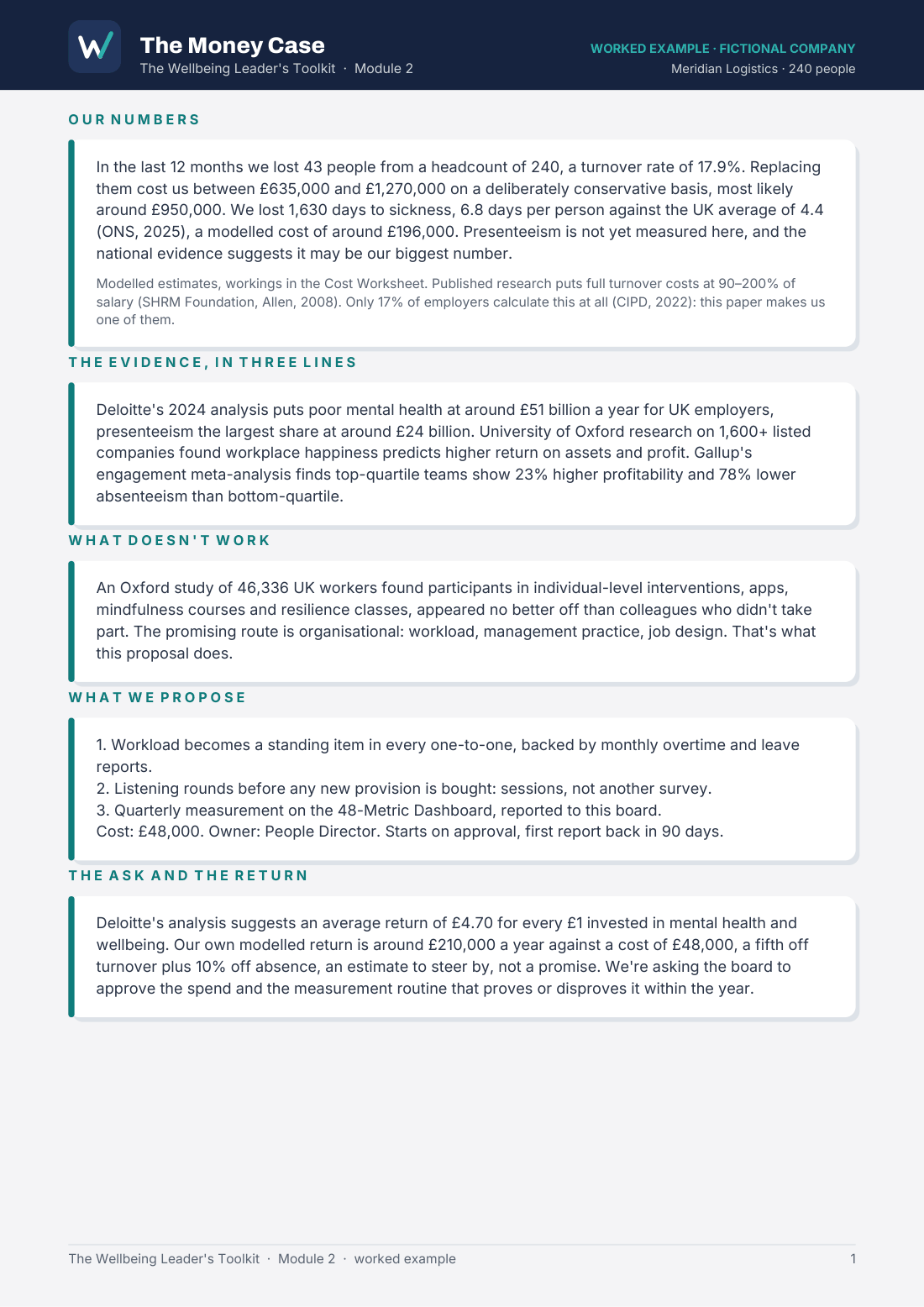
The Money Case Module 2
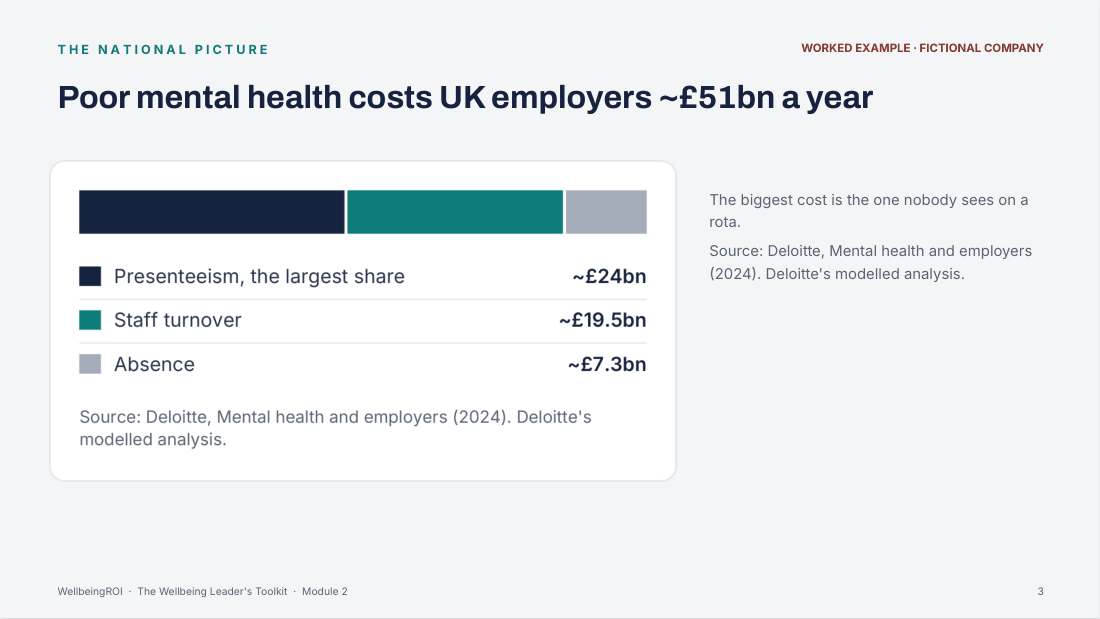
A board one-pager and an eight-slide deck, ready for your numbers, with worked examples. Every figure carries its source; every estimate says it's an estimate.
The 12-Month Strategy Calendar Module 3
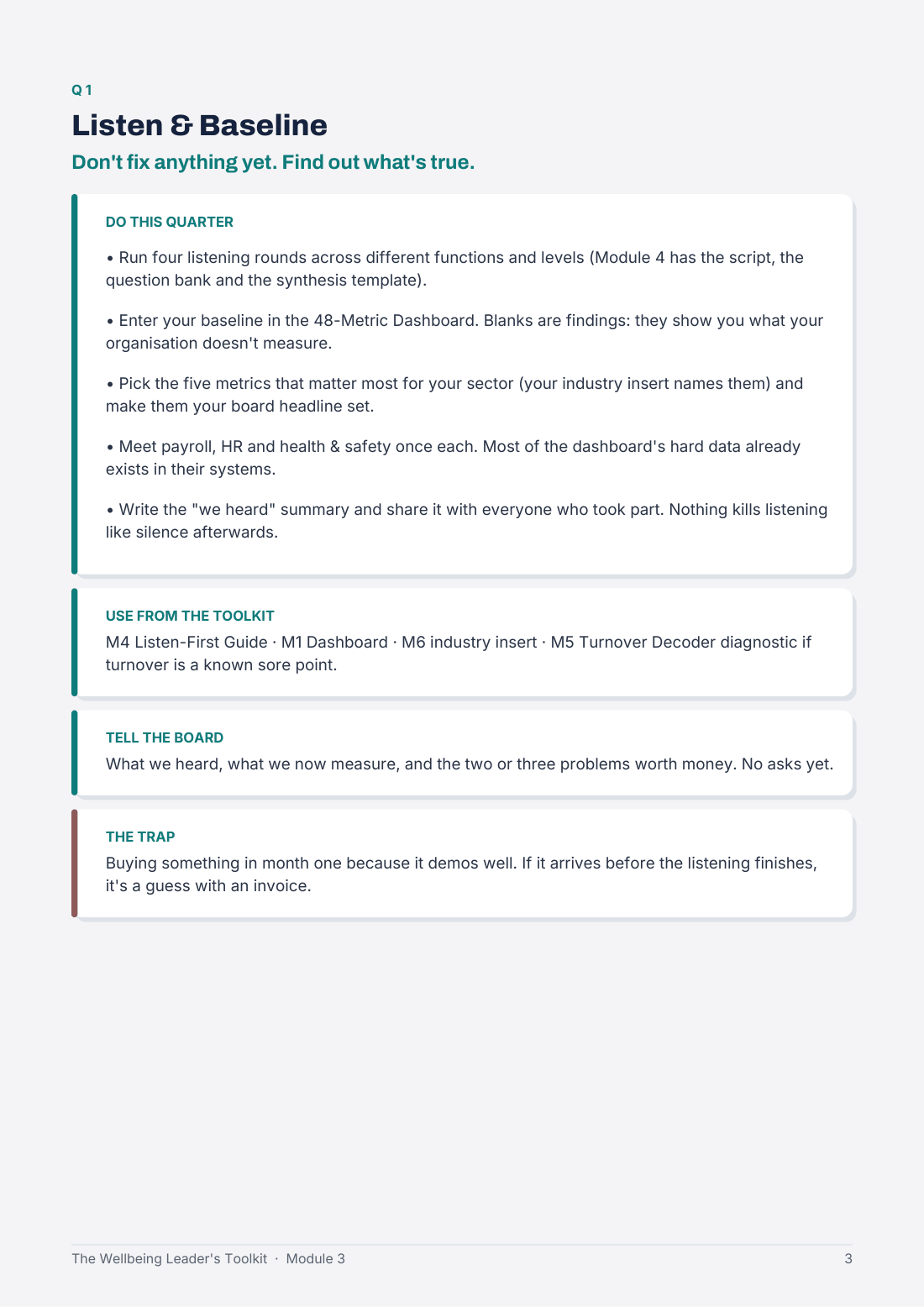
Listen and baseline, design and fix, embed, then prove it: a year of wellbeing leadership one quarter at a time, with a one-page board update template that keeps funding attached.
The Listen-First Diagnostic Guide Module 4
How to run listening sessions instead of yet another survey: facilitator script, question bank, synthesis template, and the traps that turn listening into theatre.
The Turnover Decoder Module 5
The complete £99 product, included: cost calculator worksheet, 50-question diagnostic, 24-page retention playbook, board one-pager. Turnover is most organisations' biggest measurable leak.
Industry Inserts ×7 Module 6
Two-page overlays for seven sectors: Finance & Banking · Tech & IT · Leisure & Hospitality · Education · Healthcare & Social Care · Manufacturing & Engineering · Construction. The sector's pressures, benchmarks only where they pass our source test, and which five metrics to watch first.
The Policy & Comms Pack Module 7
Flexible working policy, EAP promotion sequence, manager check-in script, annual board report: four Word templates, ready to adapt.
Start Here the path
What's in the box, the 90-day path through it, and how the modules feed each other. You will not need all 48 metrics in week one; this tells you what to touch first.
The evidence behind the design
A University of Oxford study of 46,336 UK workers found participants in individual-level interventions, mindfulness training, resilience classes and wellbeing apps, appeared no better off than colleagues who didn't take part. The route the research points at is organisational: workload, management practice, job design. That's what this toolkit measures, and what its working files are built around.
The money case writes itself once you measure it. Deloitte's 2024 analysis puts poor mental health at around £51 billion a year for UK employers, presenteeism the largest share. Oxford research on 1,600+ listed companies found workplace happiness predicts higher return on assets and profit, and Gallup's meta-analysis links top-quartile engagement to 23% higher profitability.
Sources: Fleming, Industrial Relations Journal (2024) · Deloitte, Mental health and employers (2024), modelled analysis · De Neve, Kaats & Ward, Oxford Wellbeing Research Centre WP 2304 · Gallup Q12 Meta-Analysis, 11th edition (2024). Correlational findings are reported as associations, not causes. Where a sector has no reliable benchmark, the Toolkit says so rather than inventing one.
The three questions everyone asks
"We already have a wellness programme."
Most programmes are individual-level: apps, classes, perks. The Oxford evidence above is why they don't move the numbers. This toolkit works on the organisation instead, and measures whether it's working.
"Why not hire someone?"
A dedicated wellbeing lead is the right call at a certain size, and this box is how they'd spend their first 90 days anyway. Until then: the job's structure, for the price of a team lunch rather than a salary.
"Will it fit my sector?"
Seven sector inserts are included, each naming the five metrics to watch first: Finance · Tech & IT · Hospitality · Education · Healthcare & Social Care · Manufacturing & Engineering · Construction. Everything else is sector-neutral by design, and currency-free for buyers outside the UK.
One payment. The whole system.
All seven modules, 35 files: the Dashboard workbook, PDF guides and seven sector inserts, nine editable Word templates, the board deck in PowerPoint and PDF, and the complete Turnover Decoder. Every figure sourced or labelled modelled. No subscription, no per-employee maths.
Licence: one organisation, unlimited internal use. Consultants and advisers: this licence doesn't cover use with your own clients. Sold to organisations for business use; because it's an instant download, there are no refunds for change of mind. Full terms at wellbeingroi.com/terms.
Not sure yet? Start smaller.
The free WellbeingROI Scan sizes your whole leak in about three minutes. The Turnover Decoder finds and prices the biggest single piece for £99 + tax.
Already know turnover is the fire?
The Turnover Decoder is Module 5 of this toolkit and also sold on its own. If turnover is your only problem, start there.